
Everyday English · Daily routines
Turn off
Make a light or a piece of equipment stop working.
You make a light or device stop working, usually with its switch or power button.
01 · Picture the situation
Understand it in three steps
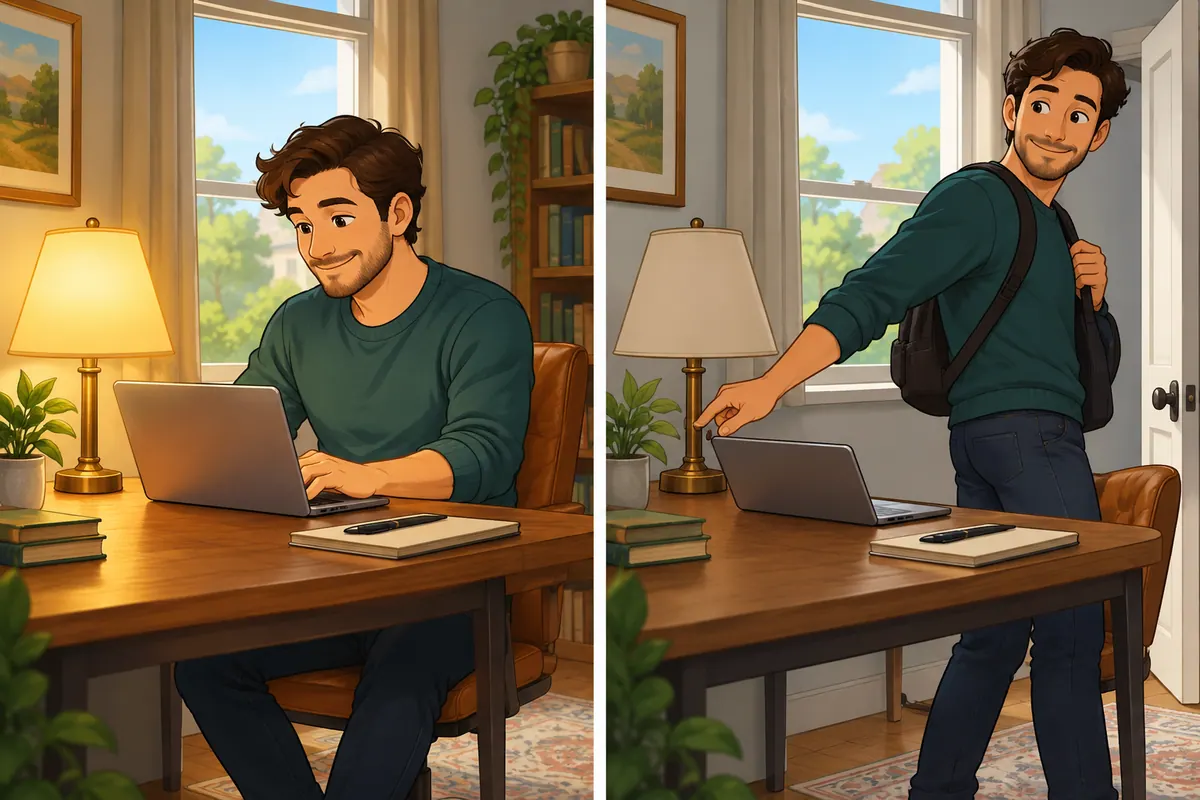
Imagine this: Everyone is leaving the classroom. The light is still on, so Jo presses the switch. Jo turns it off before closing the door.
02 · Hear it in everyday life
Examples you can use
Three natural sentences
- Please turn off the light when you leave.
- She turned her phone off during the performance.
- The fan is noisy. Could you turn it off?
A short conversation
Read the conversation aloud. Then swap roles and try it again without looking.
03 · Build your sentence
How to use turn off
You can put a noun in either position: turn off the fan / turn the fan off. Put a pronoun in the middle: turn it off.
The base form is used after can, will and to. The past simple describes a finished past event. The third form follows have or has, for example when connecting an earlier action to now.
A common mistake to avoid
It goes between turned and off in this separable pattern.
Do not confuse it: Turn off stops a device. Turn down reduces something such as its volume, brightness or heat; it may still be running.
Does it have another meaning?
Turn off can also mean leave one road for another. The device meaning in this lesson has a different object and situation.
Learn the meaning and sentence pattern together. Small words such as up and off do not have one fixed meaning in every expression.
04 · Make it stick
Try it for yourself
Choose an answer before opening the explanation. Then make a sentence about your own life.
- Turn it up
- Turn it on
- Turn it off
Check answer 1
C. Turn it off
Turn it off means stop it operating.
- turn off
- turning off
- turned off
Check answer 2
A. turn off
A direct instruction uses the base form: turn off the lights.
3. Your turn
What do you turn off before leaving home?
See a possible model and self-check
Please turn off the light when you leave.
This is one model, not the only correct answer. Check that your sentence uses the meaning taught here, the right verb form and the word order above. Change the person, place or time to make it your own.